14cm x 16cm oil on canvas
Tuesday, 20 March 2012
Thursday, 15 March 2012
The Great Escape

Oil on canvas 21cm x 14cm.
Finally got around to painting another ‘still life with a twist’ that’s been on my list for a while now. One of my favourite films when I was kid that always seemed to be the standard Christmas helping. I must admit I think I was whistling the tune from the film all the time I was painting.
Wednesday, 14 March 2012
They're Not Real.

16cm x 12cm oil on canvas.
A painting from pancake Tuesday. Yellow takes so long to dry before it can be scanned.
Monday, 12 March 2012
Painting lesson. After Kyffin Williams
Working from a painting inspired by Welsh painter Sir Kyffin Williams we will work with the palette knife.
Colours used Ultramarine blue, Burnt umber, Cadmium red, Cadmium yellow, white
Palette knife, med brush
Paint in the top layer of sky on the right hand side.
Knife in subsequent landscape layers and gradually get darker in tone as they move forward. Don’t over mix the paint on the palette do most of your mixing on the paper.
Let this dry. Go back to the top section of sky and mask off the area of the sun. Knife in the sky. Blending can be done with the knife, a dry brush or your finger.
Let all this dry and over lay your drawing of the houses on top of the landscape. Only use carbon around the lines to be traced and not the whole picture as this may all transfer black onto the painting.
Using a brush, paint in the dark houses and the walls. The same light mix can be used on the roofs with a touch of red in to warm them up on the right where the sun catches them.
Shadows are not black but a very dark green glaze.
The cows can be painted in the darkest mix of burnt umber and ultramarine, leaning toward brown. Lighter parts of the cow that would be white lean toward blue with a little white added.
Take off the mask for the sky and over paint the sun and a couple of strokes on the hills with the orange and a little white.
Use the knife again to lighten and darken areas of the picture to add a little more interest
Stand back and look to see where you could add any finishing touches, remember light against dark is a good eye catcher. You can adjust the sky if you need to with a glaze of paint that will not destroy the knife work you have created. A yellow glaze can be laid in around the sun, not the whole sky.
Draw a line of bluish white from the chimney and break this up with a wet brush.
Saturday, 10 March 2012
Monday, 5 March 2012
Painting Class. After a painting by Trevor Chamberlain

After a painting by Trevor Chamberlain. 25cm x 20cm acrylic on paper.
SARAH Hall class.
Trevor’s a fine painter who manages to record a lot of information with as few stokes of the brush as possible.
Plan the sketch and draw in the main components of the picture and darken the tones in pencil if you wish.
Block in the main shapes with a large brush and get a rough match of colour and tone. On the trees thinly block in the darkest colour first. Vary the edges of tree against sky have distant ones blended and nearer ones with some sharp edges for relief.
Using a knife put in the bridge and work with a lighter colour on the sky and trees. Allow some of the under painting to show through on the trees as shadow areas.
With a smaller brush do nothing more than suggest the shapes that make up the boat. Don’t be tempted to fiddle with perceived detail because you have a small brush.
Sunday, 4 March 2012
Dry Run. An article for painters on line.

Article for http://www.painters-online.co.uk/
Dry Run
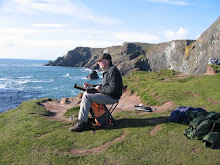
I remember when I first started painting outdoors and the enthusiasm which never seems to wane was as high as ever. I arrived on site and set up eager to complete an acrylic painting. The light was great, the weather fine and I was all alone in some distant field. I set up my portable studio when it suddenly dawned on me that I’d brought no water. I’d brought half decent brushes and didn’t want to take home dried out sticks so I was understandably gutted. I did manage to salvage something from the situation by painting using a knife which could be cleaned in the grass between colours, but had I done a dry run first, no pun intended, I could have avoided this pitfall.
It really pays to sit in the comfort of your home and set out what you’ll need and just as importantly what you won’t, as you’ll want to travel light. If you forget something here it is simply a case of popping back into the house and getting it. Make a small list of what it is you are using and write everything down, and I mean everything, even down to the painting gear you’ll wear. I’ve also had to improvise using the back of a sketchbook for a palette. Once you have the list it’s a good idea if you can keep one bag aside that’s ready to go or has the list in one of the pockets. I have a big rucksack that goes everywhere with me and has become part of the kit.
As a result of finding out what I wish I’d brought, if only I’d thought on, I now have a portable studio in my rucksack that is good to go in a really short time. In permanent residence l have a small hand held metal watercolour box, by Schmincke, a cardboard tube with a selection of brushes, collapsible water container, a collapsible brush holder, enamel plate for an acrylic palette a small selection of pencils, small box containing a craft knife blade, sponges, sandpaper etc and a couple of pads and primed cards, a roll of paper towel, a couple of rags and a baseball cap for the sun.
This is always in the bag but when I go out I will simply add to it, for instance my pochade box with the paints and brushes I’m using and my water or turps. I always take a large bottle of water for acrylics and watercolour, I can also drink from it too. The bag has a fishing stool attached if I choose to sit, but I always take the tripod to connect the box to should I choose to stand.
Have a go and make your own list, no two are probably the same although the basics won’t change much. I found most of my list the hard way at first, but a couple of dry runs were really worth it, so now it’s very rare indeed that I’m caught out on site… now where’s that paint I’m sure I packed it.
Subscribe to:
Posts (Atom)